
Key challenges –
corrosion, abrasion and temperature
Power plants in general, and waste-to-energy plants in particular, are increasingly exposed to extreme stresses due to fluctuating and inhomogeneous fuels. This results in increasingly more demanding operating conditions, with higher boiler temperatures, extreme chlorine loads and other aggressive constituents in the flue gas.
In day-to-day operation, this leads to rapidly progressing, chlorine-induced high-temperature corrosion.
Chlorine, sulphur and heavy-metal species in the combustion flue gas damage the tube surface chemically. In combination with dust and particulate loading, this results in high metal-loss rates (wastage) of the base material.
Without effective protection, boiler components often become unfit for service after a relatively short time.
Repairs to membrane walls or superheater tubes due to wastage, or in the worst case unplanned outages caused by leaks, generate substantial maintenance costs and reduce overall plant availability.
This is clearly not economically sustainable.
Many plant operators therefore rely on corrosion-protection coatings. The investment is already profitable if the service lifetime is doubled—and even greater results can be achieved: Depending on the coating material and the physical and chemical stresses involved, the service life can be tripled or quadrupled compared to uncoated pipes
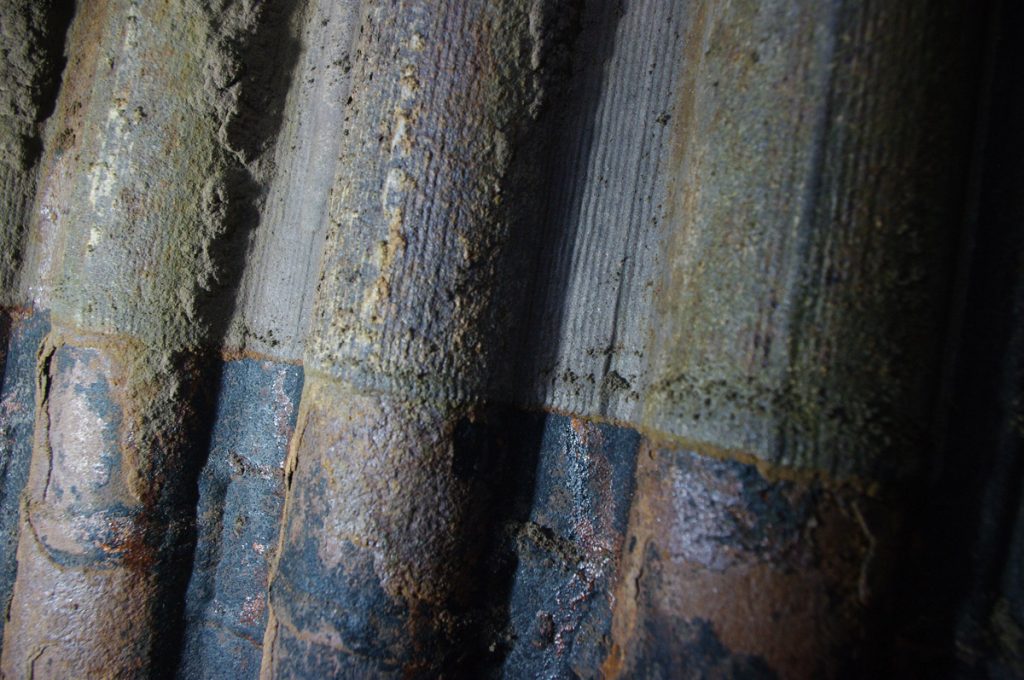
Our coatings provide effective protection for membrane walls against adverse effects such as:
- chlorine-induced high-temperature corrosion
- scaling
- abrasion
Häuser & Co GmbH coating solutions
In manufacturing technology, “coating” refers to the application of an adherent layer, formed from individual particles, onto the surface of a component. Depending on the subsequent operation conditions, both the coating process and the materials and layer thicknesses utilised will vary. In principle, a distinction is made between chemical, mechanical and thermal processes.
Overview of thermal spraying processes
At Häuser & Co GmbH, the focus is on thermal spraying processes, in particular on highly versatile plasma spraying with metallic and ceramic materials. Depending on the specific application, additional processes are also employed, such as conventional flame spraying with powder and wire, arc spraying and the laser spraying process.
Thermal energy is provided by a light/laser beam.
Coating material’s feeding form:
- With powder
- With wire
Thermal energy is provided by an electric arc (ionised inert gas).
Coating material’s feeding form:
- wires
- rods
- cords
Thermal energy is provided by a plasma arc (ionised inert gas).
There are different types of applications, such as:
- atmospheric plasma spraying (APS)
- vacuum plasma spraying (VPS)
- inert-gas plasma spraying (IPS)
- underwater plasma spraying
Thermal energy is provided by a combustible gas or liquid fuel.
There are different types of applications, such as:
- conventional flame spraying with powder or wire
- high-velocity oxy-fuel (HVOF) spraying
- detonation spraying (D-Gun or D-Spray)
- cold-gas spraying