
Plasma spraying
How does plasma spraying work?
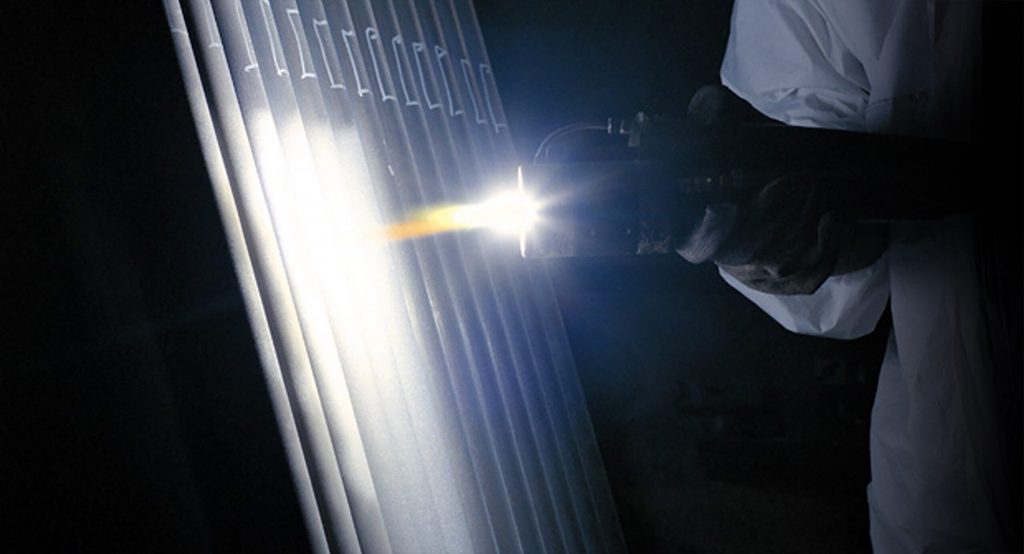
In powder-based plasma spraying, an extremely high-energy arc is used to transform an inert gas – usually argon – into a plasma state. The gas reaches temperatures of around 18,000 °C, expands to roughly 100 times its original volume and is accelerated by the gun design up to sonic velocity. The coating material is injected in powder form into the plasma jet and fully melted within milliseconds. The molten particles are propelled from the gun at high speed and bond mechanically to the pre-roughened surface.
Because the plasma recombines very rapidly after leaving the gun, component temperature remains low throughout the process (typically max. 80–100 °C), preventing distortion of the base material.
Almost all metallic and ceramic materials can be processed
The resulting coatings are characterised by high bond strength, low porosity and minimal tendency to oxidise. Thanks to the extreme temperatures in the plasma, almost all metallic and ceramic materials can be processed, provided they can be manufactured in powder form and have a defined melting point. The process therefore offers exceptional material diversity and application flexibility.
Process optimisation through subsequent heat treatment
Häuser & Co GmbH has further optimised the plasma spraying process by introducing a post-coating heat treatment.
This innovation creates a metallurgical bond between coating and substrate that effectively prevents spalling or undercutting of the coating. In addition, the layer remains completely free from iron contamination originating from the base material.
The required corrosion- and wear-protection properties are maintained consistently across the entire coating thickness, delivering an especially durable and reliable protective layer.
Operating principle
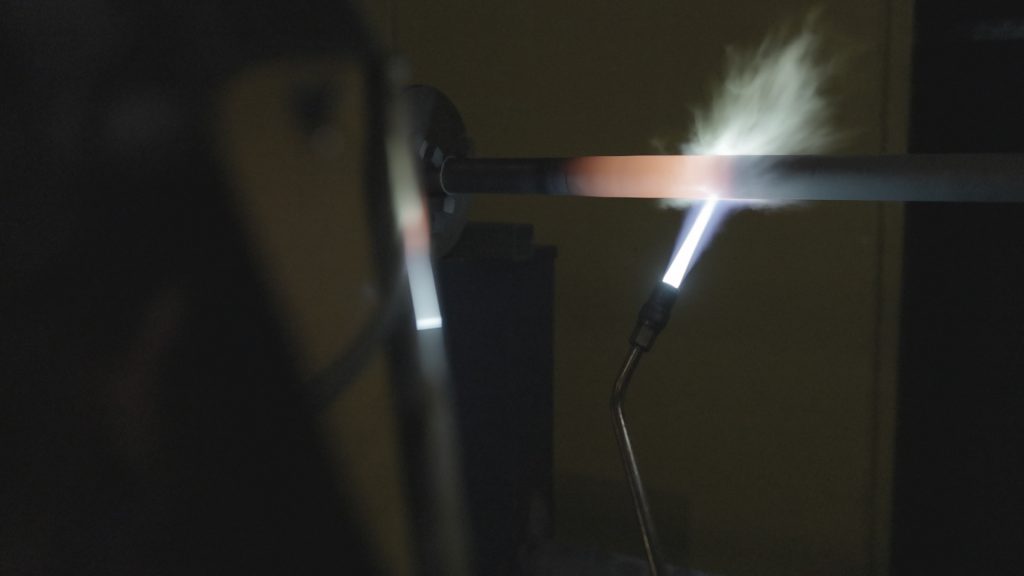
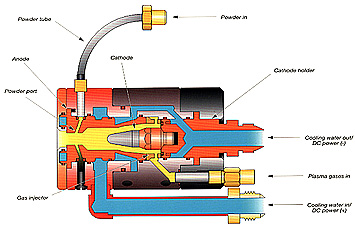
In the front housing section of the plasma gun, a gas-stabilised arc is ignited between a finger-shaped tungsten cathode and a surrounding, nozzle-shaped copper anode. The process gas – argon – is fed via an injector and heated in the arc. For certain materials, helium, hydrogen or nitrogen can be added to the argon.
Heating of the gas causes ionisation when argon is used as the plasma gas, creating an electrically conductive gas known as plasma. Ionisation increases the gas volume by a factor of around 100; combined with the defined geometry of the nozzle-shaped copper anode, this accelerates the plasma jet to velocities of up to roughly twice the speed of sound. With argon as the plasma gas, the jet temperature is approximately 18,000 °C.
To prevent the plasma gun from being destroyed at these extreme temperatures, it is intensively water-cooled – typically 25 litres per minute at a pressure of 18 bar. The cooling water is supplied via the front housing section and returned to a heat exchanger through the cathode holder located in the middle section of the gun.
The powder coating material is injected into the plasma jet – which exits the gun axially – by means of an argon carrier-gas stream. In the plasma it is melted and accelerated towards the surface to be coated. Immediately after leaving the gun, the plasma recombines and reverts to normal gaseous argon in the surrounding atmosphere.
This is the key difference between plasma spraying and all other thermal spraying processes: the hot plasma itself does not reach the coating surface. This feature provides major advantages when coating tube and tube-wall surfaces. Typically, the surfaces being coated do not exceed temperatures of around 80-100°C. The process is therefore also suitable for tubes with low remaining wall thickness (approximately 2.0 mm).
In several waste-to-energy plants, plasma-sprayed coatings have enabled service-life extensions of several years even on wall areas with very thin remaining wall thickness. With regular inspection and maintenance, plasma-sprayed coatings can achieve service lives of more than 10 years.
Where other processes cannot be used – or can only be applied with significant constraints – for example on boiler roofs or very thin-walled tubes, the plasma spraying process offers practical, maintenance-friendly solutions.